Powder cut-off and dust
Fine powder must stop cleanly enough for the seal area to remain acceptable at the intended cycle.
Plan seal-zone controlA roll-film packaging platform that forms, fills and seals bags automatically. Powder projects use the screw or auger measuring option only when the approved product, dose and film format suit that dosing route.
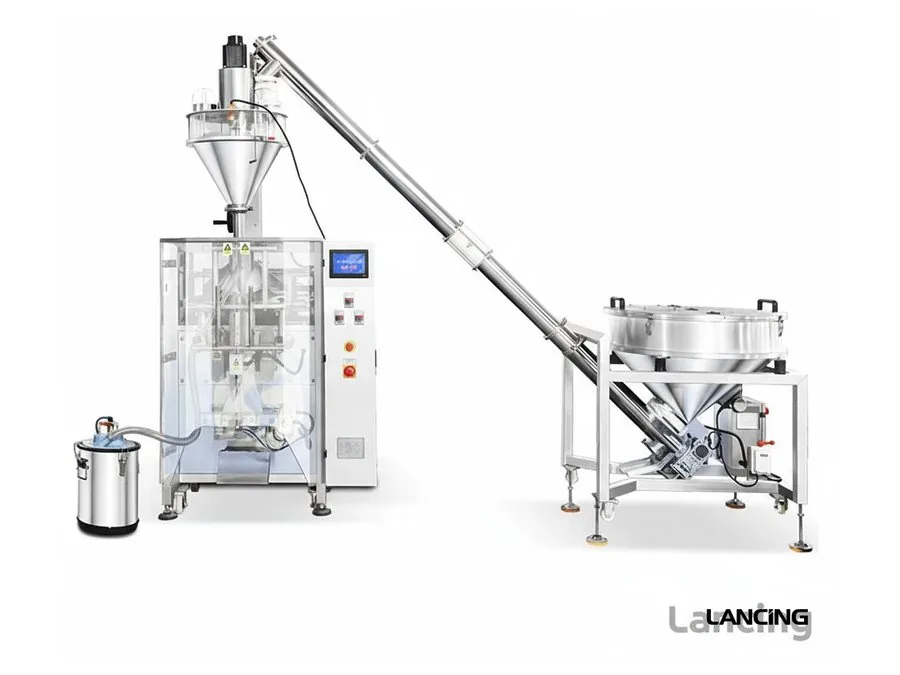
The LU-FS06 is an automatic vertical form-fill-seal packaging machine. It draws flexible film from a roll, forms a tube around the forming set, creates the bag, receives the measured product and completes the final seals and cut. For powder applications, an auger or screw dosing system is specified as the measuring method rather than treating every LU-FS06 execution as an auger machine.
The final system must match the powder, fill volume, bag dimensions, film structure, seal requirements, dust behaviour and required output. The published envelope is a machine reference, not a guarantee for every powder-film combination.
Final film, forming set, dosing method and line performance are confirmed after representative product and film trials.
| Specification | Published reference | Application note |
|---|---|---|
| Machine format | Automatic vertical form-fill-seal packaging machine | Forms bags from roll film and integrates the selected measuring method |
| Measuring methods | Electronic scale, screw / auger, measuring cup, four-head scale or manual feed options | The auger option must be selected and tooled for the approved powder |
| Reference filling range | 150–2,000 ml | Weight equivalent depends on loose bulk density, aeration and bag volume |
| Reference packaging speed | 5–80 bags per minute | Actual speed depends on dose, powder, film, bag length, sealing and feeder behaviour |
| Film range | 0.05–0.2 mm thickness; maximum width 520 mm; maximum roll diameter 360 mm; 75 mm core | Film structure and sealability must be approved through trials |
| Bag-making range | 60–250 mm width; 80–350 mm length | Forming set and seal layout are format-specific |
| Compressed air | 0.6–0.8 MPa; reference consumption 400 L/min | Site pressure, quality, storage and connected equipment must be confirmed |
| Electrical reference | 110/220 V, 50–60 Hz; approximately 3.5 kW | Final UK electrical execution is confirmed at quotation |
| Approximate machine size | 1,440 × 1,140 × 1,740 mm; approximately 500 kg | Allow additional space for auger, feeder, film loading, access and discharge |
Bag forming, dosing and sealing must remain synchronised under normal running and stop-start conditions.
| Stage | Machine action | Control point |
|---|---|---|
| 1. Supply product | The feeder maintains an approved level and product condition in the auger hopper | Prevent starvation, overfill, bridging and density shifts |
| 2. Form the film tube | Film passes over the forming set and the longitudinal seal is created | Control film tracking, registration and seal alignment |
| 3. Create the bag bottom | Cross-seal jaws close to form the base of the next bag | Keep the seal zone free from powder and folds |
| 4. Dose the powder | The auger delivers the programmed amount through the forming tube | Coordinate cut-off, drop time, dust and bag support |
| 5. Close and discharge | The top seal is formed, the bag is cut and discharged to the next stage | Verify seal integrity, coding, weight check and stable takeaway |
Fine powder must stop cleanly enough for the seal area to remain acceptable at the intended cycle.
Plan seal-zone controlThe bag must contain the loose fill and provide the required finished appearance after settling.
Plan volume and headspaceFilm structure, thickness, registration, jaw temperature, dwell and contamination tolerance must be trialled.
Review VFFS planning| Trial item | Evidence required |
|---|---|
| Powder | Representative product, normal and challenging flow condition, dust and storage history |
| Film | Production-intent roll, print registration, seal structure and approved supplier details |
| Bag formats | Minimum and maximum width, length, dose and finished-pack requirements |
| Output | Sustained accepted bags under the stated dose, film, feeder and seal conditions |
| Quality checks | Weight method, seal test, coding, reject logic and sample frequency |
| Changeover | Forming set, film, auger tooling, recipe, cleaning and restart sequence |
No. The published machine supports several measuring methods. The auger or screw option is selected for a powder application and must be specified with the appropriate hopper, tooling, controls and product feed.
No. That is a published machine envelope. The achieved rate depends on dose, powder behaviour, bag length, film, sealing, feeder capacity, dust control and the agreed finished-pack checks.
Approximate weight is calculated from the powder volume and representative loose bulk density, then verified by filling trials. Aeration, density variation and settling mean a real bag trial is required before the final format is fixed.
Dust, poor auger cut-off, excessive drop height, unsuitable timing, bag movement, airflow and a product that has not settled before the jaws close can all contribute. Dosing and sealing must be tuned together.
The published reference includes electrical power and compressed air. The final supply, pressure, air quality, storage, connected auger and feeder load, extraction and local isolation are confirmed for the project.
The reference values above are taken from the current Lancing LU-FS06 product specification reviewed on 20 August 2026. They define a machine envelope, not guaranteed performance for an untested powder, film or bag.
Review the complete bag-forming, dust and sealing decision process.
View detailsCompare the LU-FS06 with tabletop, semi-automatic and rigid-container automatic platforms.
View detailsUse the troubleshooting guide to plan cut-off, dust control and sealing timing.
View detailsInclude representative powder, fill range, film specification, required bag sizes, target output, coding, weight checking, discharge and site utilities.