Rim or thread contamination
Loose powder reaches a jar or bottle finish and affects cap application or induction sealing.
Powder can leave an auger filler in a loose or aerated condition and then settle as trapped air escapes and particles rearrange. The pack must hold the highest realistic fill volume at the filling point while still leaving a clean rim or seal zone, and the downstream line must allow enough controlled settling before capping, sealing, checkweighing or case packing.
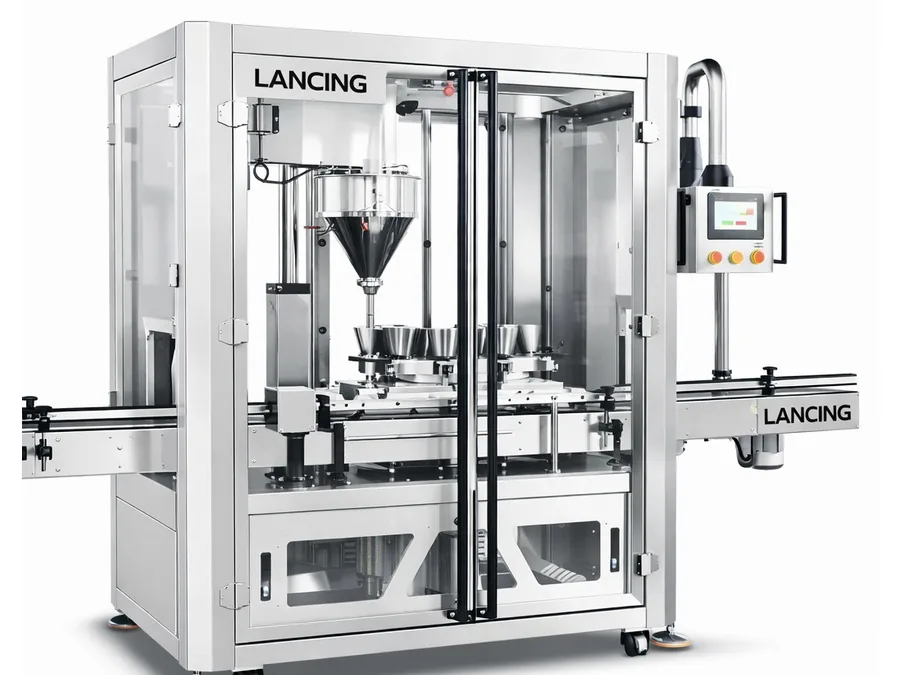
Bulk density is not a single fixed number. Conveying, hopper agitation, screw rotation and the drop into the pack can entrain air or change particle packing. The same target mass may therefore occupy more volume immediately after filling than it does after standing, vibration or transport.
If the container is sized only from a settled laboratory value, loose powder may reach the rim, contaminate a cap or seal area, or overflow during normal production. If excessive empty volume is allowed, the finished pack may look underfilled after settling. A trial should measure fill height at defined times and under the handling expected between filling and closure.
Settling devices, controlled vibration or a longer conveyor path may help some applications, but they can also create dust, compact product, damage inclusions or promote segregation. Any method should be validated against pack appearance, composition and downstream performance.
Use the production powder, actual pack and intended transfer sequence rather than relying on one density figure.
| Stage | What to check | Why it matters |
|---|---|---|
| Measure incoming condition | Record loose and settled bulk density with the method, product batch, storage and transfer history. | The value used for pack sizing must represent product at the filler. |
| Observe immediate fill height | Measure the highest normal product level directly after dosing, including dust plume and surface variation. | This is the condition that can contaminate a rim or flexible-pack seal zone. |
| Track natural settling | Record fill height after the planned conveyor dwell, closure delay and a longer reference period. | The difference shows how much apparent headspace changes before the pack reaches the customer. |
| Reproduce line handling | Include vibration from conveyors, indexing, capping, checkweighing and case packing. | Mechanical handling may compact the product differently from standing still. |
| Approve the finished pack | Check closure cleanliness, seal integrity, pack appearance, net content and product quality after normal handling. | A suitable fill must work as a finished pack, not only at the filler nozzle. |
Loose powder reaches a jar or bottle finish and affects cap application or induction sealing.
Dust or powder remains in the seal area before the jaws close.
The pack looks full at dosing and noticeably lower after settling, or is oversized from an unrealistic density.
Powder movement changes centre of gravity, checkweigher response or pack handling immediately after filling.
Pack size and line timing should be based on measured behaviour under the intended operating conditions.
Powder settles when entrained air escapes and particles rearrange into a denser packing condition. Transfer, agitation and the auger can loosen or compact the product, while vibration and time after filling can reduce its occupied volume. Particle size, shape, moisture and blend composition all influence the result.
Record the product condition and timing whenever fill height is compared, otherwise two valid measurements can appear contradictory.
There is no universal headspace percentage. The pack needs enough space for the highest realistic loose-fill volume, dust control, nozzle withdrawal, closure or seal cleanliness and any settling method, while still presenting the intended finished appearance.
Determine the requirement with actual powder and production-intent packs at minimum, nominal and maximum target fills.
Controlled vibration can settle some products, but it may also generate dust, compact cohesive powders, damage fragile particles or separate blends. The frequency, amplitude, duration and support of the pack should therefore be trialled rather than assumed.
Validate the effect on composition, pack stability, closure cleanliness and final appearance before adding a settling device.
Settling should not change the total mass in a closed system, but timing can affect checkweigher stability if powder is still moving or escaping. The weighing point should be positioned where the pack is mechanically stable and any loose dust is controlled.
The legal or quality sampling method should define tare, timing and rejected-pack handling separately from visual headspace checks.
Provide representative powder from normal and challenging batches, actual containers or film, minimum and maximum target fills, closures, and information about transfer and downstream handling. Enough product should be available to reach stable hopper and line conditions.
Photographs and timed fill-height measurements can support the trial record, but the approved pack should also be closed and handled through the normal process.
Published studies of food powders illustrate that particle structure, size distribution and bulk properties influence packing, flow and the volume occupied by a powder. Final packaging decisions must use the actual commercial product and process.
Include loose and settled density information, actual packs and closures, target fills, downstream line sequence and the required finished appearance so headspace and settling can be tested together.