LU-FM100B tabletop auger filler
Compact operator-fed powder dosing for development work, short runs and lower-volume production.
View detailsUse the model comparison to shortlist the right powder-filling platform, then confirm tooling, pack handling and performance with representative product and pack trials.
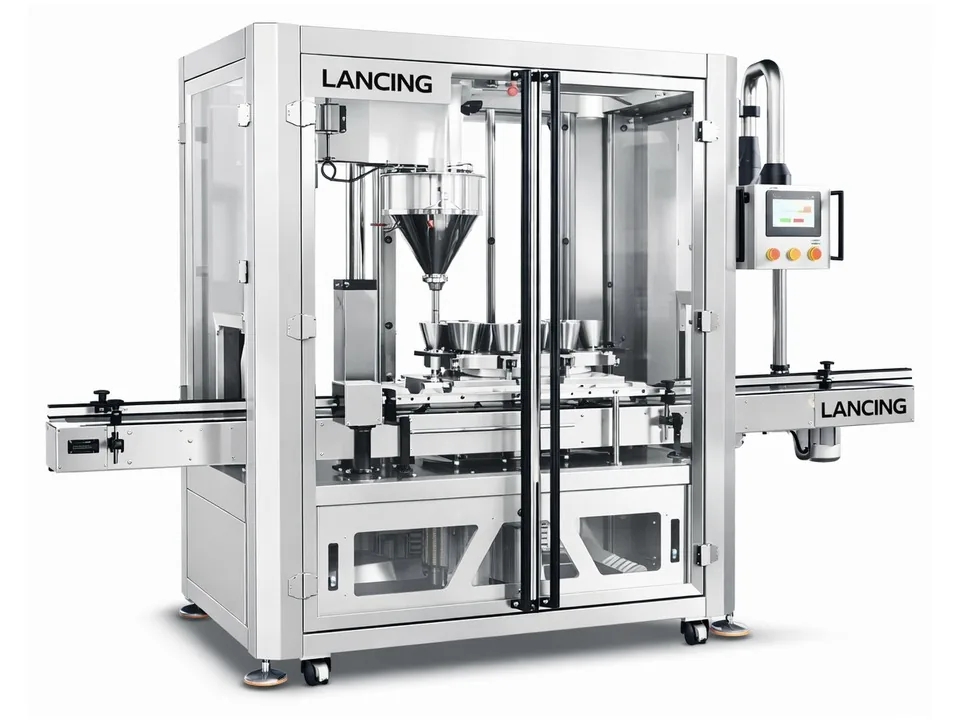
The right Lancing auger filler platform depends first on pack handling and dose scale, then on powder behaviour, checking method and the degree of automation required. The LU-FM100B is the compact tabletop route; the LU-FM710 adds a separate weighing device; the LU-FM750F provides a larger floor-standing semi-automatic platform; the LU-FM4A is a three-head automatic system for indexed rigid containers; and the LU-FS06 forms, fills and seals bags from roll film using an application-selected measuring method.
Published ranges describe machine and tooling envelopes. They do not mean every powder can run across the full range with one screw, nozzle or recipe. A representative trial is required to select the auger set, hopper conditioning, filling tube, pack support and verification method.
Use this table to identify the appropriate platform before detailed product trials and line engineering.
| Model | Machine format | Published reference envelope | Pack handling | Best initial fit |
|---|---|---|---|---|
| LU-FM100B | Compact tabletop semi-automatic filler | 0.5–2,000 g by selected tooling | Operator presents and removes the pack | Trials, pilot batches, lower-volume production and compact work areas |
| LU-FM710 | Semi-automatic filler with separate weighing device | Approximately 10–2,000 g, application-tooled | Operator presents, removes and separately closes the pack | Weight-assisted setup and checking without automatic pouch handling |
| LU-FM750F | Floor-standing semi-automatic servo filler | 5–5,000 g across published tooling windows | Operator presents the pouch, bag or compatible container | Larger fills, 50 litre hopper and modular feeder/sealer arrangements |
| LU-FM4A | Automatic three-head servo filler | 50–300 g reference range, application-configured | Containers indexed under three filling heads | Higher-output bottle or rigid-container lines with downstream equipment |
| LU-FS06 | Automatic VFFS bag-forming and sealing machine | 150–2,000 ml reference fill volume; auger is an optional measuring method | Forms bags from roll film and seals them automatically | Powder bags and pouches where dosing, film handling and seal-zone control are engineered together |
Compact operator-fed powder dosing for development work, short runs and lower-volume production.
View detailsSemi-automatic auger dosing with a separate weighing device for setup, verification and controlled correction.
View detailsFloor-standing servo auger filling with a larger hopper and published tooling windows up to 5 kg.
View detailsThree servo-controlled auger heads, indexed container handling and integration with capping, labelling or inspection.
View detailsReview the wider automatic filling route, including container indexing, conveyors and line interfaces.
View detailsPlan product feed, filling, closing, coding, inspection and accumulation as one connected production system.
View detailsRoll-film bag forming, optional auger dosing and automatic sealing for application-approved powder formats.
View detailsModel selection should be based on the operating method that the site can sustain, not only the widest published fill range.
| Decision | What to establish | Why it changes the model choice |
|---|---|---|
| Pack presentation | Manual presentation, conveyor indexing or automatic pouch handling | Separates tabletop and semi-automatic fillers from automatic container and pouch systems |
| Dose and product condition | Weight range, bulk density, aeration, flow, dust and bridging | Determines tooling, hopper conditioning and the practical fill envelope |
| Checking method | Manual sample weighing, separate scale, inline checkweigher or feedback | Changes controls, operator workflow and integration scope |
| Production sequence | Feeding, filling, settling, capping, sealing, coding and inspection | Prevents the filler from becoming isolated from the true line bottleneck |
| Changeover and cleaning | SKU count, allergen or colour risk, removable parts and access | Influences machine size, tooling sets and planned downtime |
No. Published ranges are reference envelopes achieved with selected tooling. Product density, flight filling, pack volume, nozzle clearance and repeatability requirements can narrow the practical range, so representative trials remain necessary.
A weighing device is useful for setting and checking a volumetric dose, especially where density can vary. It does not by itself make every fill automatic or legally verified; the complete checking method must be defined for the application.
A semi-automatic filler can be combined with a powder feeder, sealer, coder, metal detector, check station or conveyor. The operator still presents or transfers packs unless automatic handling is separately engineered.
The LU-FM4A should be considered when rigid containers need automatic indexed filling and the production requirement justifies three dosing heads plus coordinated upstream and downstream equipment.
Provide representative powder and packs, target weights and tolerances, expected output, product data, cleaning needs, available utilities, space and details of any feeder, capper, sealer, labeller, coder or inspection equipment.
The LU-FS06 should be considered when the project needs automatic bag forming from roll film, powder dosing and sealing in one timed VFFS process. The auger option, film and bag sizes must be approved through trials.
Specification basis: Lancing technical specification and quotation records reviewed 20 August 2026. Values shown are reference machine data, not a guarantee for every powder, dose or pack. Final construction, tooling, utilities, output and fill performance are confirmed after product, pack and application approval.
Representative samples should be used to verify bulk density, flow, dust, aeration, bridging, cut-off, pack clearance and the agreed checking method before final specification.
Include representative product and pack samples, required fill range, expected batch size, target output, available space and any feeding, sealing, capping, coding or checking requirements.