Powder feeding
A screw or vacuum feeder may reduce manual hopper loading, but capacity and filter/agitation behaviour depend on the powder and layout.
View detailsA single-head, operator-fed auger filling platform with a nominal 50 litre hopper and interchangeable tooling for dry powders packed into pouches, bags or compatible containers.
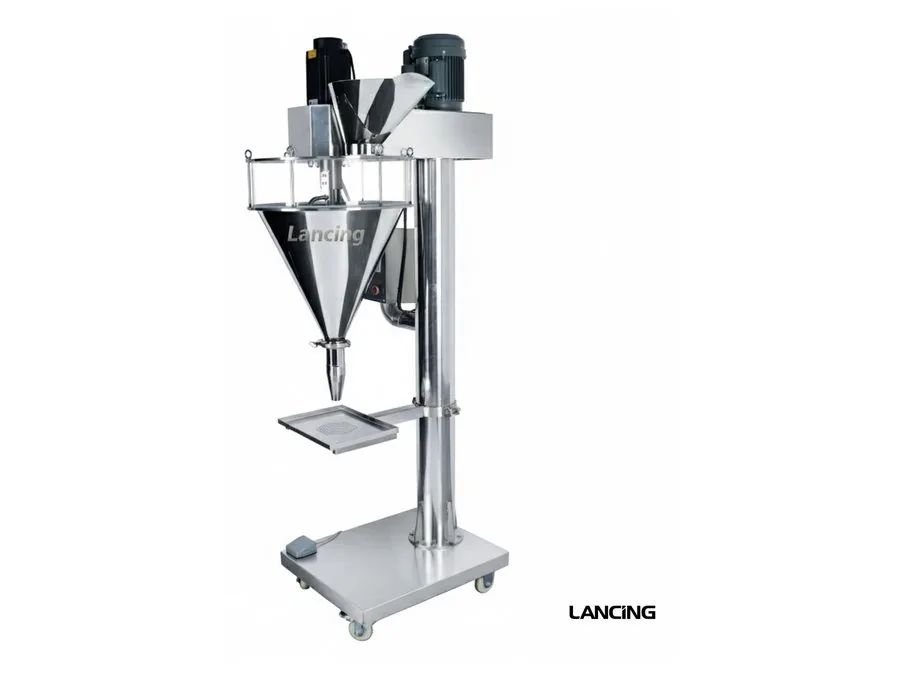
The Lancing LU-FM750F is a floor-standing, single-head servo auger powder filler with a nominal 50 litre hopper. An operator presents each pouch, bag or compatible container beneath the filling nozzle and starts the approved cycle using the touchscreen controls or foot pedal.
The platform has published auger-tooling windows from 5 g to 5,000 g. Each window requires the appropriate screw, filling tube, nozzle and recipe, and the practical result must be verified with the actual powder and pack. The machine can remain standalone or form the filling stage of a modular line with product feeding, sealing, coding or inspection.
Published values are a starting point for project engineering and product trials.
| Specification | Reference model data | Application note |
|---|---|---|
| Machine format | Floor-standing single-head semi-automatic servo auger filler | Operator presents and removes the pack |
| Hopper | Approximately 50 litres | Agitation and refill method are selected for the powder |
| Published tooling windows | 5–50 g; 50–300 g; 300–1,000 g; 1,000–5,000 g | Auger and recipe change are required between windows |
| Indicative operator-cycle output | Approximately 1–8 fills per minute | Depends on fill weight, powder flow, pack handling and settling |
| Reference accuracy | Supplier reference approximately ±1% | Final result depends on trials, tooling, density and weighing arrangement |
| Controls | PLC touchscreen with foot-pedal operation | Approved recipes should identify installed tooling and checking method |
| Weighing | Optional or integrated feedback arrangement depending on configuration | Not automatically an inline checkweigher or legal-for-trade scale |
| Utilities | 110 / 220 / 380 V variants, 50–60 Hz; approximately 2.2 kW | Final UK supply and site services are confirmed for the project |
The target dose should sit comfortably within a verified tooling window after accounting for product density and pack volume.
| Published window | Typical selection task | What still requires a trial |
|---|---|---|
| 5–50 g | Small doses using a correspondingly small auger and filling tube | Cut-off, dust, low-dose repeatability and pack opening |
| 50–300 g | Medium fills into pouches, jars or compatible containers | Bulk-density variation, headspace and settling |
| 300–1,000 g | Larger retail or ingredient packs | Cycle time, support, fill height and product feed |
| 1,000–5,000 g | Large pouches or bags where product volume permits | Bag support, hopper refill, settling and operator transfer |
A screw or vacuum feeder may reduce manual hopper loading, but capacity and filter/agitation behaviour depend on the powder and layout.
View detailsA separate or integrated weighing step can support setup and verification when the process requires it.
View detailsFilled pouches can be transferred to a band sealer, coder, metal detector or other approved downstream stage.
View detailsA broad fill range is only useful when the site can control the mechanical and recipe change safely and repeatably.
| Change task | Planning point |
|---|---|
| Isolate and empty | Define safe isolation, residual-product removal and dust-control measures |
| Remove tooling | Identify the approved auger, tube, nozzle and contact parts for each range |
| Clean and inspect | Use the site-approved method and check for wear, damage or retained product |
| Reassemble | Confirm correct part identity, alignment, fasteners and guarding before startup |
| Select recipe | Match the installed tooling to the correct stored settings |
| Verify production | Produce and weigh startup samples before releasing saleable packs |
No. The published envelope is divided into tooling windows, and each range uses the appropriate auger and related parts. Product density and pack volume can narrow the practical range further.
Output depends on the auger dose time, fill weight, powder flow, hopper condition, operator presentation, pack settling, weighing and the downstream sealing or closing step.
A suitable feeder can be integrated, subject to powder trials, conveying route, capacity, filter condition, level control and the effect of refill on product condition in the filling hopper.
No. Weighing feedback supports setup or correction, but the complete result still depends on stable product feed, correct tooling, measurement quality and the approved control procedure.
Dry food and ingredient powders can be considered subject to product trials, required hygienic construction, cleaning method, site risk assessment and final application approval.
Specification basis: Lancing technical specification and quotation records reviewed 20 August 2026. Values shown are reference machine data, not a guarantee for every powder, dose or pack. Final construction, tooling, utilities, output and fill performance are confirmed after product, pack and application approval.
Representative samples should be used to verify bulk density, flow, dust, aeration, bridging, cut-off, pack clearance and the agreed checking method before final specification.
Compare the smaller semi-automatic platform with an approximately 25 litre hopper and separate scale.
View detailsReview automatic three-head bottle filling when indexed line production is required.
View detailsUse the verified model hub to compare pack handling, dose envelope and automation level.
View detailsInclude representative product and pack samples, required fill range, expected batch size, target output, available space and any feeding, sealing, capping, coding or checking requirements.