Single head
Flexible batches, frequent changes, modest output or a downstream process that sets the line rate.
A multi-head auger filler can increase available dosing capacity by filling several indexed packs during a machine cycle, but additional heads also increase product-feed, tooling, control, cleaning and verification requirements. A single head is often the clearer choice for flexible or lower-output work; several heads become useful when the complete line can present, fill, release and close packs at the required sustained rate.
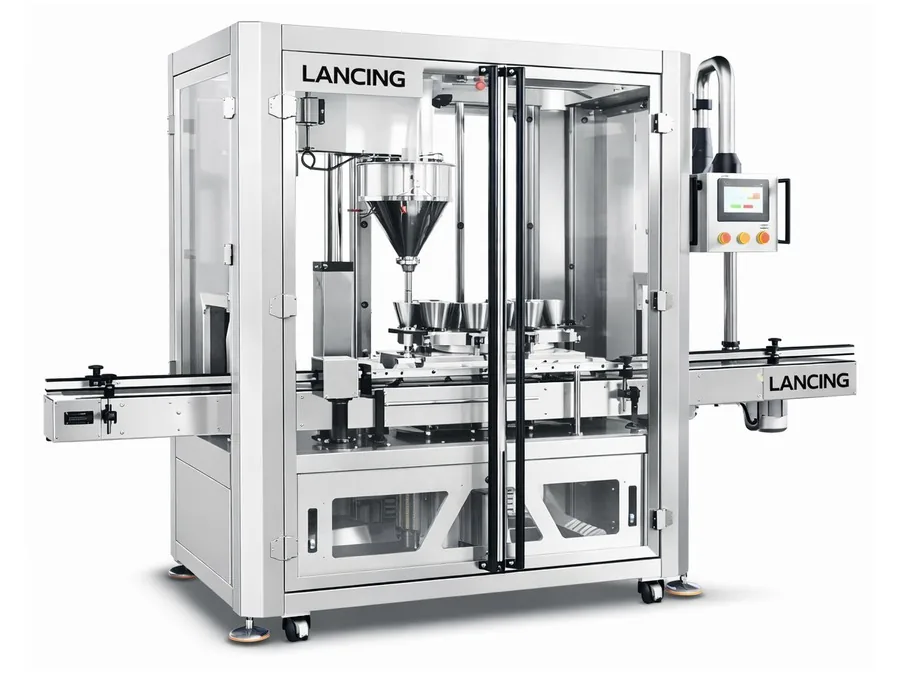
One auger head gives one dosing path to set, clean, calibrate and monitor. It can suit semi-automatic operation, lower automatic outputs, frequent product changes and lines where the downstream capper or sealer would not benefit from more filler capacity.
Twin-head or multi-head systems can distribute work across parallel dosing stations. That may reduce the cycle demand on each screw or allow several packs to be filled together, but the product must reach every hopper or head consistently and each dosing path must be verified. The controls also need to identify a head-specific fault without losing traceability.
The comparison should use accepted finished packs per minute, changeover time, cleaning time, refill strategy and the sampling burden. Doubling head count does not automatically double the saleable output of the complete line.
Record how the selected arrangement behaves during normal running, refill, stop, reject and changeover conditions.
| Stage | What to check | Why it matters |
|---|---|---|
| Required sustained output | Calculate accepted packs after downstream closing, checks, normal stops and planned replenishment. | The filler should not be oversized around a theoretical peak the line cannot sustain. |
| Product supply | Define whether heads share a hopper, use separate hoppers or receive product from a common feeder. | Unequal level or conditioning can create head-to-head variation. |
| Tooling and calibration | List the auger, tube and nozzle set for each head and the method used to verify it. | Parallel heads require controlled mechanical setup and traceable results. |
| Fault and reject logic | Decide what happens when one head, container position or weight check fails. | The line must protect product quality without mixing accepted and suspect packs. |
| Cleaning and changeover | Time safe access, dismantling, inspection, reassembly and verification for all heads. | Extra capacity may be offset by longer changeovers on short campaigns. |
Flexible batches, frequent changes, modest output or a downstream process that sets the line rate.
A balanced step up where two controlled dosing paths match the container index and closure equipment.
Higher-output indexed or rotary systems where product feed, pack handling and verification are engineered together.
Independent heads may support special applications, but cross-contamination, traceability and control logic become more complex.
Head count is a system decision covering powder presentation, packs, controls and downstream capacity.
Not automatically. Two heads can deliver two doses during an indexed cycle, but the actual gain depends on container presentation, dose time, hopper supply, discharge, capping or sealing, rejects and normal stops. The line may gain less than twofold if another stage becomes the bottleneck.
Ask for the output basis and prove it with the production powder, packs and agreed downstream sequence.
Multi-head systems may use separate hoppers, divided product zones or another engineered feeding arrangement. The correct choice depends on product flow, refill method, cleaning and the need to keep conditions similar at every head.
Where separate hoppers are used, level and conditioning should be monitored so one head does not receive a different bulk condition from another.
Each dosing path should be mechanically identified, set with the approved tooling and checked using a traceable sample plan. Results should retain the head or container-position identity so a systematic difference can be found and corrected.
A combined average across all packs can hide one high or low head, so head-specific review is important during setup and FAT.
It usually has more product-contact parts and access points, so safe dismantling, cleaning, inspection and reassembly can take longer. The effect depends on whether components are shared, how they are removed and whether dedicated change parts are available.
For short campaigns or allergen-sensitive products, cleaning time can outweigh the production benefit of extra heads.
A single-head automatic filler can be the better choice when required output is moderate, format changes are frequent, product cleaning is demanding or the capper, sealer or inspection stage already limits the line. It can also simplify development before a process is scaled.
Select the simplest arrangement that meets the sustained production and quality requirement with suitable capacity margin.
Provide the powder, pack dimensions, target dose, accepted-output requirement, campaign length, cleaning needs and downstream machine capacities so the useful head count can be justified.