Frequent pack changes
A simpler inline arrangement may reduce format-part complexity, subject to the actual container set.
An inline auger filler moves packs along a conveyor and stops or controls them beneath one or more filling heads, while a rotary layout transfers packs around an indexing or continuous carousel. Neither arrangement is universally better: the decision depends on container stability, head count, required finished-line output, changeover frequency, available footprint and the downstream closure process.
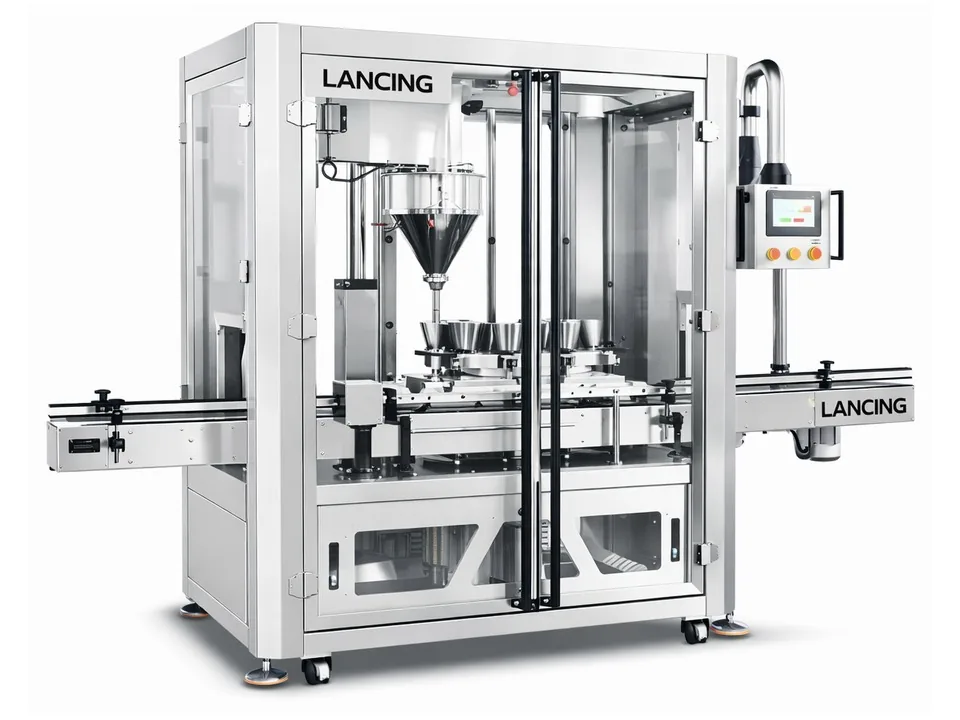
Inline systems are often straightforward to connect with conveyors, cappers, induction sealers, labellers and checkweighers. They can provide clear access and a familiar linear product flow, but the index, fill and release sequence must prevent unstable containers from queuing or colliding.
Rotary systems can present several containers to multiple stations within a compact machine envelope and may suit applications where several filling heads or additional operations are arranged around a common pitch circle. They introduce more format parts and transfer points, so container control, guarding, access and changeover should be assessed carefully.
Headline filler speed is not enough. The preferred layout is the one that sustains the required accepted packs per minute after normal replenishment, rejects, stops, capping, sealing and downstream recovery are included.
Use the same product, pack, output and acceptance assumptions when comparing two quotations.
| Stage | What to check | Why it matters |
|---|---|---|
| Container presentation | Inline: guides, gating, screws or indexing control on a conveyor. Rotary: starwheels, pockets or turrets around a carousel. | The pack must remain stable and accurately located under the nozzle. |
| Head count and cycle | Inline systems may use one or several heads; rotary layouts can distribute containers around multiple stations. | More heads do not guarantee proportional output if feed, discharge or downstream equipment is limiting. |
| Changeover | Compare guide, pocket, starwheel, nozzle-height and recipe changes for every format. | A fast machine can lose its advantage when frequent format changes are difficult or error-prone. |
| Access and cleaning | Review access to hoppers, augers, nozzles, spill areas, guards and under-machine surfaces. | Cleaning time and safe access affect real availability. |
| Line integration | Test start/stop signals, accumulation, reject handling and recovery with the capper or sealer. | The finished-line rate is controlled by the slowest or least stable stage. |
A simpler inline arrangement may reduce format-part complexity, subject to the actual container set.
A rotary or indexed multi-head arrangement may provide an orderly pitch, but needs robust pack handling.
Inline equipment can fit naturally between existing conveyors and downstream modules.
A rotary arrangement may concentrate operations, although access and service clearance still need space.
The answers should be tied to accepted finished packs, not an isolated catalogue cycle rate.
No. A rotary layout can support multiple stations and high container flow, but actual output depends on powder feed, dose time, container infeed, discharge, rejects, closure equipment and normal stoppages. An inline multi-head system can also achieve strong output when those stages are balanced.
Compare a sustained line trial using the production powder and containers rather than machine labels alone.
The easier layout is the one with fewer and simpler approved format parts for the real pack family. Inline systems may rely mainly on guides, stops and nozzle height; rotary machines may require starwheels, pockets or pitch parts. Some rotary systems use flexible handling, so the actual parts list and adjustment method should be compared.
Ask for a demonstrated changeover sequence and a record of settings and components.
Yes. Inline automatic fillers can use multiple auger heads where the product feed, container indexing, available width and control sequence support them. Each head needs suitable product presentation, tooling and verification, and the line must manage any head-specific fault or refill condition.
A multi-head design should be accepted as a complete system, not simply as repeated single-head hardware.
Both layouts can integrate with downstream machinery. Inline filling usually transfers directly onto a conveyor, while a rotary filler needs a controlled discharge back to the line. The best choice depends on container spacing, accumulation, cap application, induction sealing, label presentation and reject strategy.
Define interface signals, maximum back pressure and restart behaviour before the machines are ordered.
The trial should prove stable container infeed, location under every nozzle, consecutive dose results, clean release, reject or fault behaviour, restart after a stop, hopper replenishment and transfer to downstream equipment. It should also show whether the target output is maintained under the agreed operating conditions.
Use production-intent containers and enough powder to reach a representative steady-state run.
Include production containers, closure details, target output, changeover formats, available footprint and downstream machinery so inline and rotary routes can be compared on the same basis.