Weight-control architecture

What is the difference between loss-in-weight and gain-in-weight powder dosing?

Gain-in-weight dosing measures material arriving in a receiving vessel or pack. Loss-in-weight dosing measures material leaving a weighed supply hopper and feeder. Either principle needs a defined process and control sequence; a continuously controlled mass flow is not automatically the same as an accepted net weight in each retail pack.

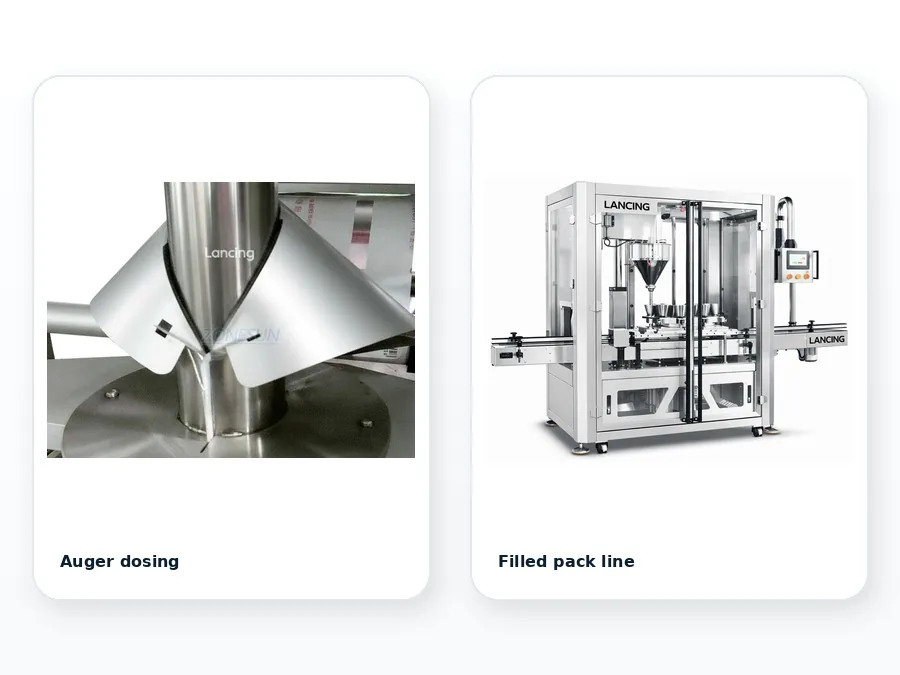
Auger filling equipment associated with weighing and dose-control selection
Lancing powder filling machinery. Configuration depends on the application.
Practical selection guidance

Identify the scale location before comparing accuracy claims

Ask which parts are physically supported by the weighing system and which signal controls the dose. A bag or jar on a scale, a separate weigh hopper above the pack, and a feeder weighed together with its supply hopper are different architectures. The phrase “weigh-assisted auger” is not enough to identify one.

Also distinguish measurement during the fill from inspection afterwards. A downstream checkweigher may inspect every pack and provide feedback for future settings, but it does not necessarily control the current dose. Product lost between a source measurement and the final pack still needs to be accounted for.

Practical selection guidance

Compare the control boundary

Four ways weighing can interact with powder dosing
MethodWhat is measuredImportant trial boundary
Gain-in-weight batchIncreasing mass in the receiving vessel or supported packTare, feed cut-off, settling and the final stable weight
Loss-in-weight batchDecreasing mass of the supply feeder during a batchThe relationship between discharged mass and material actually received
Continuous loss-in-weightWeight loss over time to control a mass-flow targetRefill behaviour and the averaging interval, as well as rate stability
Checkweigher feedbackFinished packs after fillingReject handling, feedback delay and traceability to the correct filler setting
Practical selection guidance

Plan refill and weighing disturbances

In gain-in-weight operation, product arriving after the stop command can affect the final weight. Fine-feed, cut-off and stabilisation behaviour must therefore be tested with the real powder and pack. In loss-in-weight operation, adding material during refill changes the source weight; the controller needs a defined strategy for that period.

A load cell measures forces acting on its supported system, so the installation matters as well as the sensor. Review vibration, mechanical contact, attached services and any pressure effects with the equipment supplier. A hose, frame or extraction connection should not unintentionally become a changing load path.

Record stable operation and transitions separately. A good steady-state result can conceal a refill-related deviation, while an overall average can hide repeating overshoots. Keep the event sequence with the actual measured data rather than reporting only a single average.
Practical selection guidance

Write an acceptance requirement that matches the process

For discrete packs, define the target net quantity, tare method, actual pack, trial sequence, sampling or inspection method and agreed acceptance limits. For continuous dosing, define the required mass-flow rate, measurement interval, refill conditions and how a downstream process will verify receipt. Do not substitute one test for the other.

The fill sample calculator summarises a set of pack weights. It does not measure a continuous feeder’s dynamic flow performance, assess measurement uncertainty or determine packaged-goods compliance.

No particular loss-in-weight configuration is promised for the Lancing model range by this comparison. Use it to clarify the requested control principle, then have the supplied machine and its measurement method confirmed in writing.

Practical selection guidance

Questions to resolve before specifying the equipment

Is loss-in-weight dosing always more accurate than gain-in-weight filling?

Neither name establishes a universal accuracy advantage. The result depends on the powder, dose or flow requirement, scale installation, control response, refill method and acceptance procedure. Compare measured performance against the same defined task. A continuous mass-flow result and a sequence of finished-pack net weights are different measurements.

Is net-weight filling another name for loss-in-weight feeding?

Net-weight filling describes controlling or establishing product quantity without including the package tare. Loss-in-weight describes measuring material leaving a weighed source. A system can deliver a net product quantity using different weighing arrangements, so the supplier should identify the actual scale location and control sequence rather than relying on either label.

Can checkweigher feedback correct the pack that was just measured?

A downstream checkweigher normally measures a pack after that pack has already been filled. Feedback can alter later doses, and the measured pack may be accepted, rejected or sent for controlled rework. It should not be assumed to receive an automatic correction unless the line specifically contains a validated correction stage.

What should be tested during a loss-in-weight feeder refill?

The test should identify the refill start and finish, the control strategy during refill and the resulting discharge behaviour over an agreed measurement interval. Include recovery to normal running and repeat the event under representative conditions. For pack filling, verify the finished packs affected by the transition rather than checking the hopper signal alone.

Practical selection guidance

Technical sources and application limits

Prepared for Lancing’s powder-filling buyers. These sources explain general principles; they do not certify a particular Lancing configuration or replace an application-specific assessment.