Bulk density
Aeration, settling, moisture and product-batch variation can change the mass delivered by the same volumetric setting.
An auger filler should be calibrated with the actual powder, auger tooling, hopper conditions and pack format intended for production. Set an initial dose, weigh consecutive fills on suitable equipment, adjust the dose against the measured result and then verify that the average and variation remain acceptable through refill, stoppage and normal operating conditions.
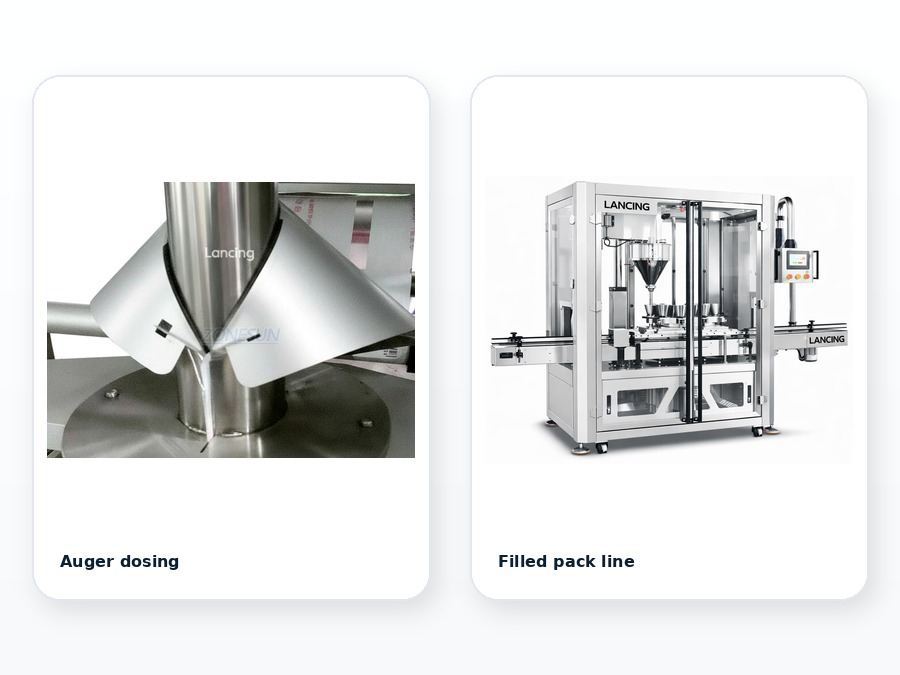
Auger filling is normally volumetric: the machine dispenses a controlled number of screw rotations or a controlled servo movement, while the packed quantity is confirmed by weight. The calibration therefore belongs to a particular combination of product, auger, tube, agitation, hopper level, recipe and operating method. A setting established with one powder or one bulk-density condition should not be assumed to apply to another.
Use weighing equipment that is suitable for the target quantity and the organisation's quality system. Tare the empty pack consistently, record individual results rather than only the average, and keep rejected setup fills separate from saleable production.
For UK packaged goods, the packer remains responsible for meeting the applicable quantity-control duties. The official packaged-goods guidance and equipment and records guidance explain the legal framework; the correct control plan depends on the product, pack and production system.
Use the sequence as a project checklist, then confirm the final arrangement with representative product and packs.
| Stage | What to check |
|---|---|
| Stabilise the setup | Fit the intended auger and tube, load representative powder, set agitation and allow the product around the auger inlet to reach a repeatable condition. |
| Establish an initial dose | Use the machine recipe or manual jog function to produce trial fills. Avoid correcting after every isolated result before a pattern is visible. |
| Weigh and record | Weigh consecutive fills with a consistent tare method. Record individual values, the average and the spread so underfills and instability are visible. |
| Adjust one variable at a time | Change the dose setting in a controlled way. If flow is unstable, correct the product feed, hopper level or agitation before relying on repeated dose compensation. |
| Challenge normal disturbances | Check performance after a hopper refill, a short stop, a restart and the expected operator or container-handling sequence. |
| Define production checks | Agree who checks, how often checks are made, what limits apply, what happens after an out-of-limit result and how records are retained. |
Aeration, settling, moisture and product-batch variation can change the mass delivered by the same volumetric setting.
Product depth, refill method and agitation can alter how consistently powder enters the auger flights.
Auger diameter, pitch, tube clearance and the way the dose stops influence both quantity and tailing.
Container position, start signal timing, stoppages and downstream delays can change the condition at the next fill.
These answers describe the practical variables that should be checked before a machine or process is accepted.
Calibration on an auger filler means linking a machine dose setting to the measured mass delivered for a defined product and setup. It is not a permanent universal value. The calibration is valid only while the relevant powder condition, auger tooling, hopper arrangement, agitation, recipe and operating sequence remain sufficiently comparable.
A useful calibration record identifies the product batch or condition, tooling, target, machine setting, weighing equipment and measured results. That record makes later troubleshooting more reliable because the team can distinguish a product or process change from a machine-setting change.
There is no single test-fill count that suits every powder and risk level. The sample must be large enough to reveal the average, the variation and any trend after refill or restart. A quality-critical or variable product generally needs a more demanding verification plan than a stable product packed under close operator control.
Agree the sample plan through the packer's quality procedure, legal duties and acceptance criteria. Do not select only favourable fills or stop testing as soon as one correct result appears; consecutive results are more informative than isolated checks.
Fill weights can drift after setup because powder condition and feed conditions change during the run. Hopper level may fall, fresh product may be more aerated, humidity may alter flow, the machine may stop and restart, or powder may compact differently around the auger. These effects can change mass without changing the programmed auger movement.
Verification should therefore include normal production disturbances, not only a short uninterrupted run. See the guidance on hopper level and fill consistency and scaling trials into production.
Weigh feedback is worth considering when normal product variation causes a repeatable bias that operators would otherwise correct frequently. A checkweigher or weighing stage can feed measured results back to the filler, but the control logic must distinguish a genuine trend from an isolated disturbance so it does not over-correct a stable process.
Feedback does not remove the need for stable product feed, correct tooling or independent quantity-control checks. It is one control layer within the overall process. Review the checkweighing guide before defining the interface.
Send the powder, target fill, pack format and required quality checks so Lancing can review the dosing and verification approach with the machine enquiry.
Summarise measured net product weights without assuming they represent the whole production run. Use readings from the same identified trial condition and keep their sequence with the source record. Subtract the correct pack tare before entry; gross weights from different containers can conceal or create apparent filling variation.
Enter 2–500 net weights in grams, separated by spaces, new lines or semicolons (or a comma followed by a space). Use a decimal point and no thousands separators or unit labels. Include a zero reading when the measured net fill is genuinely zero; do not omit a failed fill. The reading limit is a calculator limit, not a recommended regulatory sample size.
Enter your values, then calculate.
Calculations stay in this browser. Inputs are not sent, saved, tracked or added to an enquiry. Results are planning aids, not a machine specification or a legal acceptance decision.
The mean is the sum of readings divided by their count. Sample standard deviation is the square root of the sum of squared deviations from the mean divided by n − 1. Mean minus target is a signed quantity: a negative value means this sample mean is below the entered target.
Mean positive excess averages only the portion of each reading above target across all readings. Short fills count as zero excess; they do not cancel overfill. For example, the illustrative readings 99 g, 100 g and 101 g against a 100 g target have a mean of 100 g, a sample standard deviation of 1 g and mean positive excess of about 0.333 g per pack. This does not declare the batch acceptable.
A small or selected sample cannot certify legal quantity compliance, a model’s accuracy or long-term process capability. The calculator does not determine measurement uncertainty, check scale calibration, test distribution assumptions or produce a confidence interval. Separate startup, stable running, refill and restart groups rather than hiding them in one combined mean.
Statistical definition: NIST/SEMATECH measures of scale. Continue with fill-weight root causes or identify which part of the system is actually weighed.
Discuss the measured trial conditions with Lancing • Prepare your enquiry details