Low-level underfill
Dose mass falls as the hopper approaches empty because the screw flights are not replenished consistently.
Hopper level can affect auger filler consistency because the amount and condition of powder above the auger inlet influence how completely and uniformly the screw flights refill. A controlled operating band, suitable agitation and a feeder or level-control strategy can reduce variation caused by running nearly empty or overfilling the hopper.
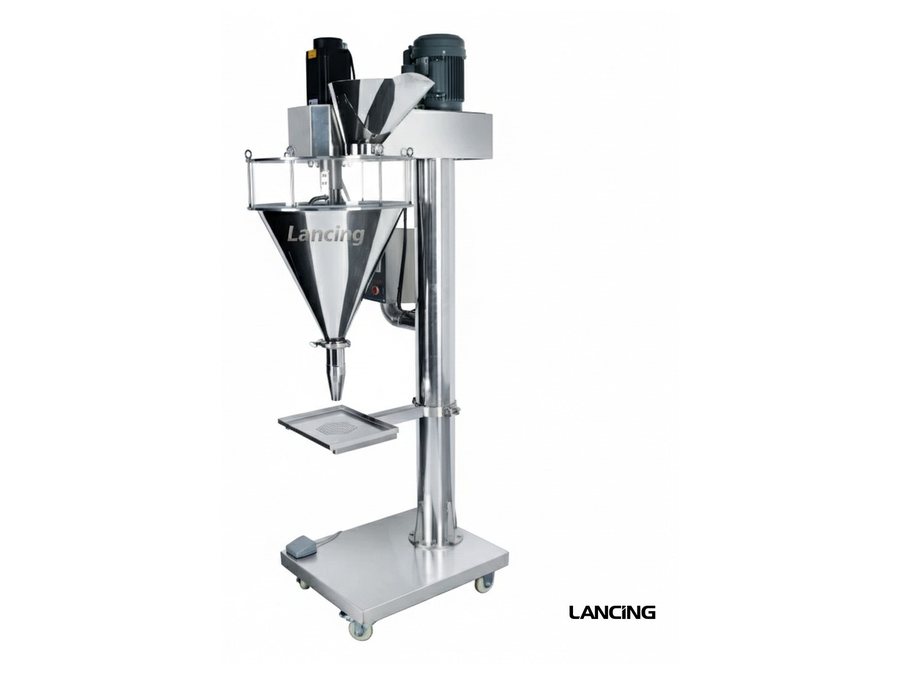
The term head pressure is often used informally to describe the effect of the powder column and its compaction above the auger inlet. Dry powders do not behave like simple liquids, so the relationship is influenced by bridging, aeration, wall friction, agitation and the way fresh product enters the hopper.
If the hopper runs too low, the auger may not refill consistently. A large refill can then introduce aerated product, compact the existing bed or temporarily change the load on the screw. Both conditions can shift the mass delivered by an unchanged volumetric setting.
The aim is not always to keep the hopper completely full. The aim is to maintain a repeatable product condition within a proven level range and to replenish in a way that does not create a larger disturbance than the filler can tolerate.
Use the sequence as a project checklist, then confirm the final arrangement with representative product and packs.
| Stage | What to check |
|---|---|
| Observe the usable level band | Identify where fill results remain stable and where low-level starvation or high-level compaction begins. |
| Select suitable agitation | Use only enough agitation to prevent bridging and feed the auger without over-compacting or damaging the powder. |
| Control replenishment | Choose manual loading, vacuum transfer or a screw feeder with a refill quantity and rate that preserve the hopper condition. |
| Position level sensing | Place sensors where they represent the product available to the auger, allowing for uneven surfaces and powder build-up. |
| Verify refill cycles | Check fills immediately before, during and after refill so a short-lived bias is not missed by occasional quality checks. |
Dose mass falls as the hopper approaches empty because the screw flights are not replenished consistently.
Fresh product changes aeration or compaction and several fills shift after loading.
The visible hopper appears full while little product reaches the auger inlet.
Fill results change when agitation timing or speed changes, indicating that product presentation is a key variable.
These answers describe the practical variables that should be checked before a machine or process is accepted.
In auger filling, head pressure usually describes the influence of the powder bed above the dosing screw on how the auger flights fill. It is not a simple hydraulic pressure. Product depth, compaction, aeration, wall friction and agitation combine to determine the condition entering the screw.
Use the term as a process description rather than a fixed machine specification. The useful control measure is a proven hopper level and refill method that maintain repeatable fills.
A larger hopper does not automatically improve accuracy. It can reduce refill frequency, but it may increase product dwell time, compaction, cleaning effort and the amount exposed to humidity. A large changing powder column may also create more variation than a smaller hopper replenished within a controlled band.
Size the hopper around production logistics, powder behaviour, cleaning, operator access and the chosen feeder. The best capacity is the one that supports stable operation rather than the largest volume available.
A screw feeder and level control should replenish the filler hopper before starvation while avoiding a sudden large addition that changes powder condition. The sensor provides a demand signal, and the feeder supplies product at an agreed rate or batch until the upper control point is reached.
The logic needs to handle sensor build-up, empty-feed conditions, alarms and safe stopping. Trial the interface with the real powder because a level sensor that works with one product may not detect another reliably.
Fill weights can change after a hopper refill because fresh powder may be more aerated or may compact the material already around the auger. The refill can also disturb bridging, change agitation load or briefly flood the screw inlet. The programmed dose remains the same while the mass per auger movement changes.
Include post-refill results in the calibration and verification plan. If the shift is repeatable, improve the refill method before relying on frequent recipe correction.
Share the powder, hopper-loading method, batch size and target output so Lancing can review the auger filler, level control and replenishment arrangement together.