Supplement pack assembly

Where should a scoop be inserted on a protein powder filling line?

A scoop can be inserted before or after powder filling, but the choice must be tested with the actual scoop, tub, dose and closing process. Early insertion can affect tare and filling clearance; later insertion can disturb the powder surface or obstruct the closure. The line must also verify the intended insert is present.

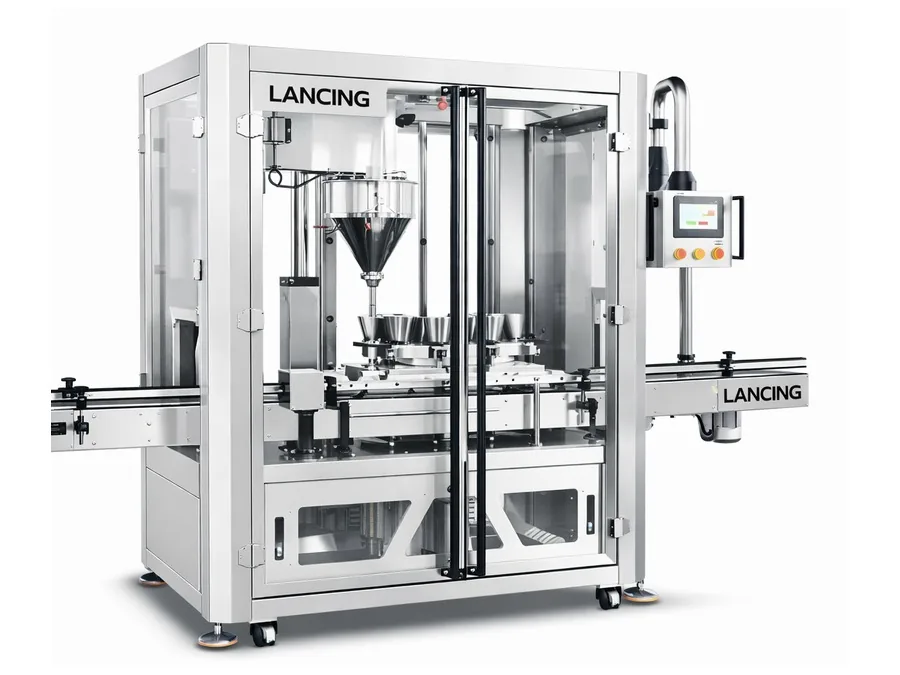
Powder filling machinery for supplement tubs and other rigid containers
Lancing powder filling machinery. Configuration depends on the application.
Practical selection guidance

Treat the scoop as a controlled pack component

Record the scoop drawing, overall length, bowl size, material, orientation and approved variants alongside the container specification. The open neck must permit insertion in a repeatable orientation, not simply be wider than one dimension of the scoop. Show the closure and any liner or seal as part of the finished assembly.

Keep this guide separate from a dosing claim. A scoop provides a volume, and the mass it holds depends on the product and filling method. This page does not establish serving-size accuracy or a nutritional declaration. Food-contact documentation and product-specific labelling requirements remain part of the pack owner’s review.

Practical selection guidance

Compare the insertion positions

Questions to resolve with physical packs during a line trial
SequencePotential advantage to assessPotential failure to challenge
Scoop before powderInsertion into an empty, visible openingScoop obstructs the nozzle, tips the pack or changes the tare basis
Scoop after powderDosing proceeds without an insert in the filling pathScoop rests above the product, displaces powder or reaches the closure zone
Separate inspection before closingA defined opportunity to verify pack assemblyPresence is inferred from the feeder cycle rather than verified at the pack
Practical selection guidance

Decide what the line must actually detect

A feeder command is not evidence that the right scoop entered the right tub. Define the required check: one insert, correct variant, acceptable orientation or unobstructed closure. Different checks may need different sensing or inspection arrangements. Agree what happens when an insert is missing, doubled, misoriented or unconfirmed.

Challenge the complete transfer sequence, not only the point of insertion. A scoop can rebound, bridge across the opening or move when the tub accelerates. Dust may complicate an optical check. Any reject system must retain the association between the inspected tub and the tub actually diverted.

Practical selection guidance

Keep product mass separate from pack assembly mass

If a scoop is inside a tub when the tub is tared, its mass is included in that tare. If it is added later, a downstream gross-weight check has a different assembly to evaluate. Record precisely which components are present at each weighing stage, including lids, liners and scoops.

Do not compensate for a missing scoop by increasing the product setting, or assume a gross-weight deviation uniquely identifies a fill error. Agree the pack bill of materials and tare approach with the quality team. Weight checks and scoop-presence checks answer different questions.

Practical selection guidance

Build a scoop-and-powder trial brief

  1. Supply approved tubs, lids, liners and every proposed scoop variant.
  2. Define the powder condition, fill weight and available headspace.
  3. Trial the proposed insertion position and verify filling clearance.
  4. Run normal transfers, pauses and restarts using the actual timing.
  5. Challenge missing, double and incorrectly oriented inserts under controlled conditions.
  6. Inspect the closed pack and reconcile detection, rejects and accepted output.

A scoop feeder or inspection option is not implied to be standard on any Lancing auger filler. Send the intended pack assembly with the enquiry so the additional equipment, integration and acceptance scope can be assessed explicitly.

Practical selection guidance

Questions to resolve before specifying the equipment

Can a protein scoop interfere with an auger filling nozzle?

A scoop can interfere with the filling path when it sits across the tub opening or projects into the nozzle clearance. The risk depends on scoop orientation, nozzle size and insertion sequence. Test the actual components rather than assuming that a scoop which fits inside the finished tub cannot obstruct filling.

Does a weigh check prove that a scoop is present?

A weigh check alone does not necessarily prove scoop presence because product variation and other pack components also affect gross weight. A defined presence check may be required in addition to quantity inspection. Agree how missing and double inserts will be detected and rejected without changing the product fill to disguise an assembly defect.

How much headspace should be reserved for a scoop?

The necessary headspace depends on the scoop envelope, orientation, product surface and closure geometry. No universal percentage applies. Trial the highest expected filled volume and the least favourable acceptable scoop position, then verify closure and sealing without trapping the scoop or displacing powder into the sealing area.

What happens when a line changes to a different scoop size?

A scoop-size change may require changes to feeding, orientation, insertion timing, guides, inspection settings and the documented tare basis. The changeover should identify the correct scoop variant and clear the previous one. First-off checks should confirm the complete pack, not only the powder weight or the new feeder recipe.

Practical selection guidance

Technical sources and application limits

Prepared for Lancing’s powder-filling buyers. These sources explain general principles; they do not certify a particular Lancing configuration or replace an application-specific assessment.