Check stability
Lightweight or tall containers may need support during indexing.
Use rotary indexing when container control, dwell time or a compact footprint makes more sense than a straight inline conveyor route.
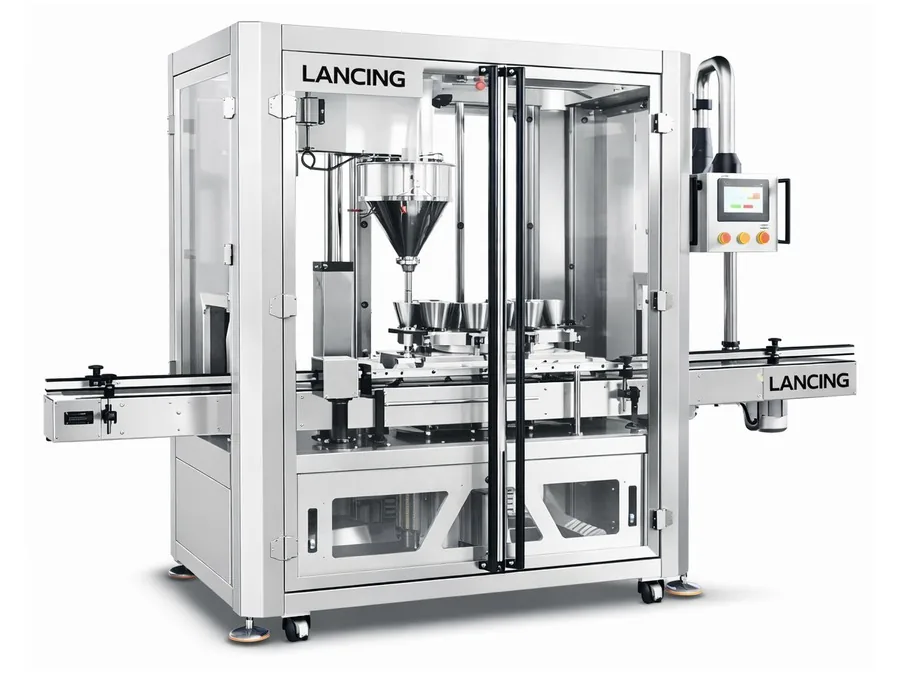
A rotary auger filling machine can be considered when containers need controlled indexing under one or more filling heads in a compact automatic layout. Rotary systems may suit jars, bottles or tubs where container positioning, dwell time and downstream handling must be coordinated.
The decision should compare footprint, output target, cleanability and how caps, seals, labels or checkweighing will connect to the filler.
A useful quote depends on more than the product name. These checks help choose a realistic machine route.
| Factor | What to check | Why it matters |
|---|---|---|
| Container control | How the container is presented and held | Rotary systems rely on consistent positioning at each station |
| Dwell time | Time needed to dose, settle or check the pack | Determines whether rotary indexing helps or restricts output |
| Change parts | Container format changes and cleaning expectations | Affects downtime and suitability for mixed production |
| Downstream flow | How filled containers leave the filler | Prevents bottlenecks after the dosing stage |
Lightweight or tall containers may need support during indexing.
Guards, hoppers and tooling must remain accessible for cleaning and changeover.
A rotary filler can only help if capping, sealing and labelling can keep pace.
These answers are written to help production, engineering and procurement teams prepare a realistic enquiry.
A rotary auger filler is not automatically faster than an inline filler. Speed depends on container handling, dosing time, number of heads, product settling, cap or seal stages and how quickly containers can enter and leave the system.
Rotary auger filling is usually considered for powders going into rigid containers such as jars, bottles or tubs where controlled indexing is helpful. Suitability still depends on the powder flow, dust level, cleaning requirement and container format.
Rotary filling normally needs containers that can be positioned repeatably. Very unstable, flexible or highly variable containers may need additional handling or may be better suited to a different layout.
Yes, but the line should be planned as a complete sequence. The filler, capper, sealer, labeller, coder and inspection stage all need compatible pitch, speed, footprint and accumulation.
Include product samples, fill target, pack format, target output and any cleaning, dust-control, sealing, coding or integration requirements.