Composition changes through the batch
Laboratory or process checks show a trend even though the filler settings remain unchanged.
Powder blend segregation can change the composition delivered to each pack even when the auger filler repeats the same programmed dose. Differences in particle size, density, shape or surface behaviour may separate during transfer, hopper replenishment, vibration and discharge, so blend uniformity must be checked across the real production sequence rather than inferred from fill weight alone.
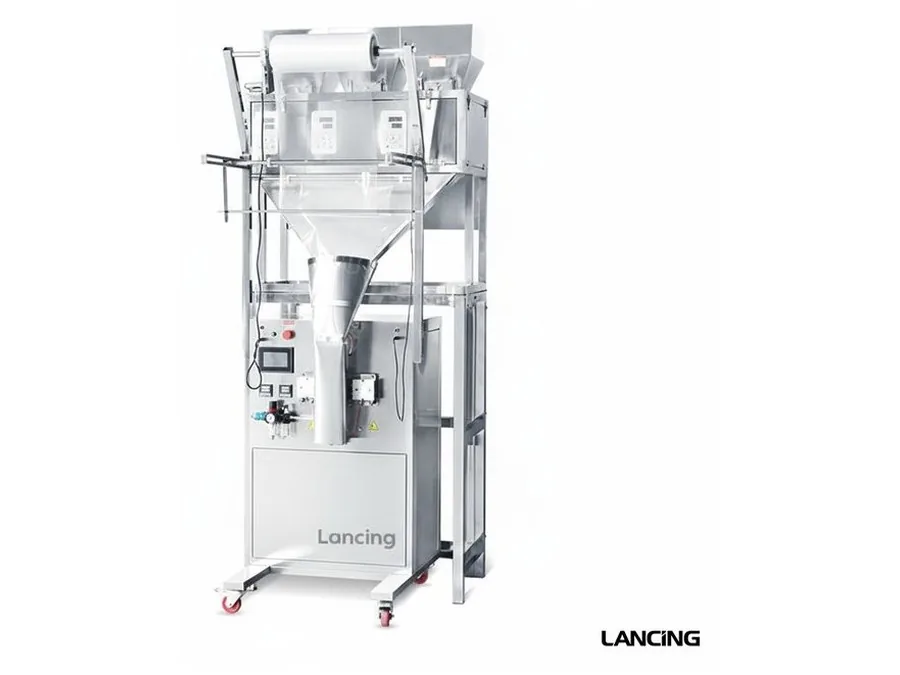
An auger meters a controlled volume of product from the hopper, but it cannot restore ingredients that have already separated upstream. If fine, coarse, light or dense fractions move differently through a feeder, hopper or screw, consecutive packs may have similar gross weights while the ingredient ratio changes.
The practical control is to preserve the approved blend condition and verify composition at meaningful points in the run. Trials should reproduce the production mixer, transfer method, hopper refill pattern, normal dwell time and stop-start sequence. Beginning, middle and end samples may then be compared using the product-specific quality method.
Agitation is not automatically a cure. The wrong agitator speed or geometry may promote migration, compact a cohesive fraction or damage fragile inclusions. The filler, feeder and hopper should therefore be assessed as one material-handling system.
Document where the blend can separate and what evidence will show whether the packaged product remains acceptable.
| Stage | What to check | Why it matters |
|---|---|---|
| Characterise the blend | Record particle-size differences, density differences, fragile inclusions, fines and any ingredients present at low concentration. | Large property differences can make components respond differently to vibration, air movement and gravity. |
| Reproduce transfer | Use the intended tote, vacuum transfer, screw feeder or manual loading method during trials. | A blend that is uniform after mixing may change during conveying or repeated hopper replenishment. |
| Control hopper condition | Define minimum and maximum level, refill quantity, agitator setting, dwell time and response to a stoppage. | Head pressure and internal circulation can change how different fractions reach the auger. |
| Sample the run | Take agreed samples from the start, steady state, after refill, after a stop and near the end of the batch. | A single composite sample may conceal a time-related shift. |
| Release by evidence | Use the site quality method to compare composition as well as pack weight where blend uniformity is critical. | Weight control and formulation control answer different questions. |
Laboratory or process checks show a trend even though the filler settings remain unchanged.
Different fractions collect in the feeder, hopper, auger tube or finished pack.
Results change after a bulk bag, tote or feeder replenishes the hopper.
Fragile pieces break, or large inclusions fail to enter the dosing path consistently.
These questions separate fill-weight control from the separate task of maintaining formulation uniformity.
No. Consistent fill weight shows that the total mass is controlled within the chosen sampling method; it does not prove that every ingredient remains in the correct proportion. A pack can meet its target weight while a light, coarse or low-dose component is over- or under-represented.
Where composition matters, agree a product-specific analytical or process check in addition to normal weight verification.
Hopper agitation may keep a cohesive powder moving, but it does not automatically prevent segregation. Depending on the blend, agitation can create circulation paths, move fines into voids, damage inclusions or increase the number of handling cycles experienced by the product.
The agitator type and setting should be selected through representative trials and assessed across a complete batch, including refills and stops.
Samples should be taken at points that can reveal a time-related or handling-related change: after initial stabilisation, during steady running, immediately after a hopper refill, after a planned stop and near the end of the batch. The exact number and location should follow the site quality plan and the risk presented by the formulation.
Record the batch, mixer, transfer route, hopper condition and pack sequence so an unexpected result can be traced to the process condition.
A screw feeder can improve controlled hopper replenishment, but any transfer step may change a blend. The effect depends on screw geometry, speed, residence time, vibration, drop height and the differences between blend components.
Use production-intent feeder settings during trials. If composition changes after transfer, the feeder and filler should be reviewed together rather than correcting only the auger dose.
Provide the full ingredient form at a non-confidential level, particle and density differences, fragile or low-dose components, mixing and transfer method, target fill range, pack format, output target and the quality method used to confirm blend uniformity. Representative mixed product and production-intent packs are especially important.
Also identify any restrictions on remixing, recirculation, sampling, cleaning or product recovery before a trial is planned.
Published powder-mixing research shows that material properties and process conditions can influence blend behaviour. It does not replace validation of the actual commercial formulation, transfer route and filling process.
Include representative mixed product, the normal transfer and refill method, target fill range, production pack and the checks used to confirm composition so the trial can reproduce the real risk of segregation.