True internal access
The smallest internal section through the neck and shoulder decides the usable nozzle envelope.
An auger filler can fill some narrow-neck bottles when the outlet or nozzle can be aligned safely with the opening and displaced air has a controlled escape path. Suitability depends on the neck dimensions, bottle shoulder, stability, powder flow, required fill volume and the dust created during the drop, so production-intent samples are essential.
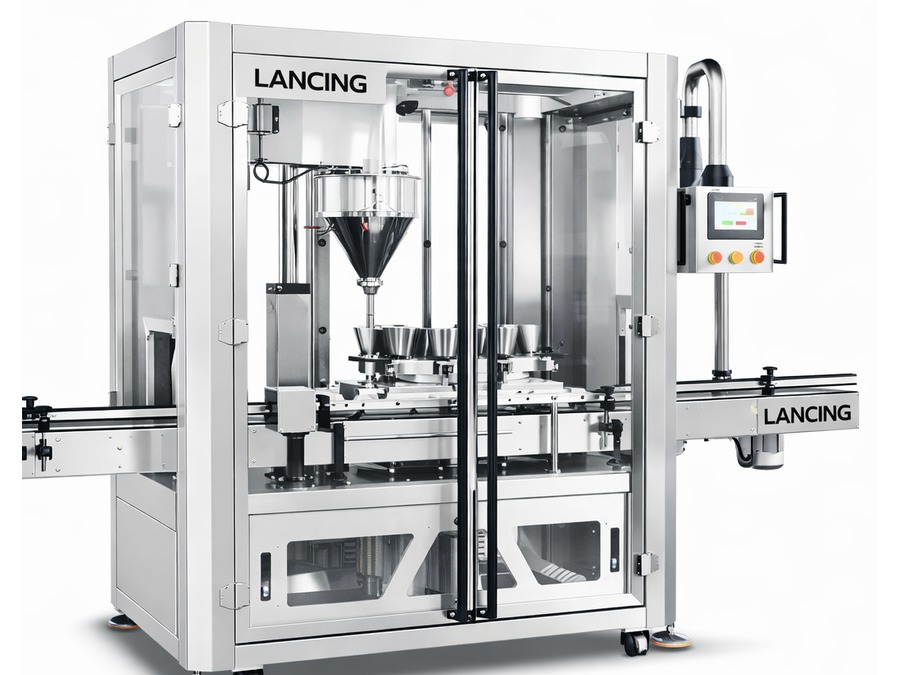
A narrow neck restricts nozzle access and the route by which air can leave the container. If powder enters faster than displaced air can escape, dust may blow back towards the neck, contaminate the closure area or interrupt the dose. A long bottle shoulder can also make a nominal neck diameter misleading because the internal clearance reduces below the opening.
The machine review should consider the bottle as a three-dimensional part: opening, thread, neck height, shoulder profile, body diameter, base, overall height and material. Lightweight bottles may need support or neck handling, while unstable shapes may require controlled indexing rather than a simple conveyor stop.
Where a bottle cannot accept a practical powder nozzle, a wider-mouth pack, a different dosing route or a redesigned transfer interface may be the safer and more repeatable choice.
Use the sequence as a project checklist, then confirm the final arrangement with representative product and packs.
| Stage | What to check |
|---|---|
| Bottle drawings and samples | Provide the internal and external neck dimensions, thread or finish, shoulder profile, overall dimensions and representative physical bottles. |
| Product and fill range | State the powder, target weights, loose fill volume, expected settling and the amount of headspace required for closure. |
| Closure sequence | Identify caps, liners, induction seals or other closure components that make rim cleanliness important. |
| Container handling | Explain whether bottles arrive upright, how they are indexed and whether the line must handle more than one size. |
| Dust and air behaviour | Trial how displaced air exits and whether local extraction, a vent path or a different nozzle position is needed. |
The smallest internal section through the neck and shoulder decides the usable nozzle envelope.
A tall or lightweight bottle may move during nozzle approach, dosing or conveyor acceleration.
Insufficient free volume can cause blowback or leave powder on the neck and closure surfaces.
Multiple bottle sizes may require guides, timing components, nozzle height settings or different handling methods.
These answers describe the practical variables that should be checked before a machine or process is accepted.
The most important dimensions are the minimum internal neck diameter, neck height, shoulder profile, overall height, body diameter and base footprint. The external thread or closure finish also matters because it determines where a nozzle or guide can safely approach without damaging the pack or contaminating the closure surface.
A drawing is useful, but physical samples reveal moulding tolerances, flexibility, static behaviour and stability. Supply the intended production bottle rather than a similar catalogue size whenever possible.
The nozzle does not always need to enter the bottle, but reducing the free-fall distance can improve control for dusty or aerated powders. Insertion may be limited by the neck, shoulder, bottle movement and the need to avoid contact. The best position is the closest safe and repeatable position proven during trials.
A nozzle that enters deeply can trap displaced air or pick up product from the bottle interior. The design must balance drop distance, venting, hygiene, changeover and mechanical clearance.
Displaced air and dust can be managed by controlling the powder entry rate, maintaining a vent path around the nozzle, reducing free fall and using correctly positioned local extraction where required. The bottle should not be sealed around the nozzle so tightly that escaping air carries powder back through the neck.
Observe the complete dose, including the final cut-off and bottle departure. Dust appearing after the auger stops may need settling time or a cleaner cut-off rather than more extraction.
A wide-mouth container is often the better option when the narrow neck prevents a suitable nozzle, causes unacceptable dust blowback, creates long filling times or leaves insufficient headspace. It can also simplify cleaning, operator access and closure-area protection, although the commercial pack requirement must be considered.
Compare the total packaging process rather than the filler alone. A bottle that is easier to fill may need a different cap, label or case arrangement, so review the complete pack before committing to a change.
Provide representative bottles, closures, powder and target fills so Lancing can review nozzle access, air escape, indexing and downstream closure requirements together.